
Do run cold water before, during and after grinding. Do feed scraps in small amounts. Do grind small chicken bones and fruit pits occasionally to scour the chamber. Do not pour grease down, ever. Do not feed stringy skins, coffee grounds in quantity, pasta, rice or anything that swells. And do treat the disposal as a finisher of plate scraps, not a second bin. Those six lines are most of the article; the rest is the why.
What the disposal actually does
A disposal does not have blades. It has a spinning plate with impellers that throw food against a grind ring, shredding it into particles the water carries away. That mechanism explains its real limits: stringy material wraps rather than shreds, starchy food turns to paste, and grease passes the grind in liquid form and re-solidifies in your pipes, downstream, where the actual damage happens. The unit survives most abuse cheerfully. It is the drain line that collects the bill.
Thompson's Station kitchens add two local twists. Our hard water crusts the splash guard and chamber, which is part of why smells linger here. And big family cooking (holiday birds in Canterbury, weekend gatherings in Bridgemore Village) pushes holiday loads through units sized for Tuesday nights. The dos and don'ts below are written for real kitchens, not laboratory ones.
The do list
Do run a strong flow of cold water the whole time the unit runs and for fifteen seconds after the grinding stops, so particles are carried deep into the line. Cold, not hot: cold keeps fats solid so the unit can grind them into small particles instead of melting them onto the pipe wall. Do feed gradually. Do grind a tray of ice now and then to knock buildup off the grind plate, and citrus peel for the smell. Do run the unit regularly; a disposal left idle for weeks can seize and grows stale smells in its chamber.
Do know the two rescue moves before you need them: the reset button on the underside, and the hex socket in the centre of the base that an Allen key turns to free a jam. Power off first, always, and retrieve objects with tongs. Half the dead disposals we are called to in 37179 are a tripped reset and a bottle cap, fixed in minutes by an owner who knew where to look. Our disposal repair page walks it through.
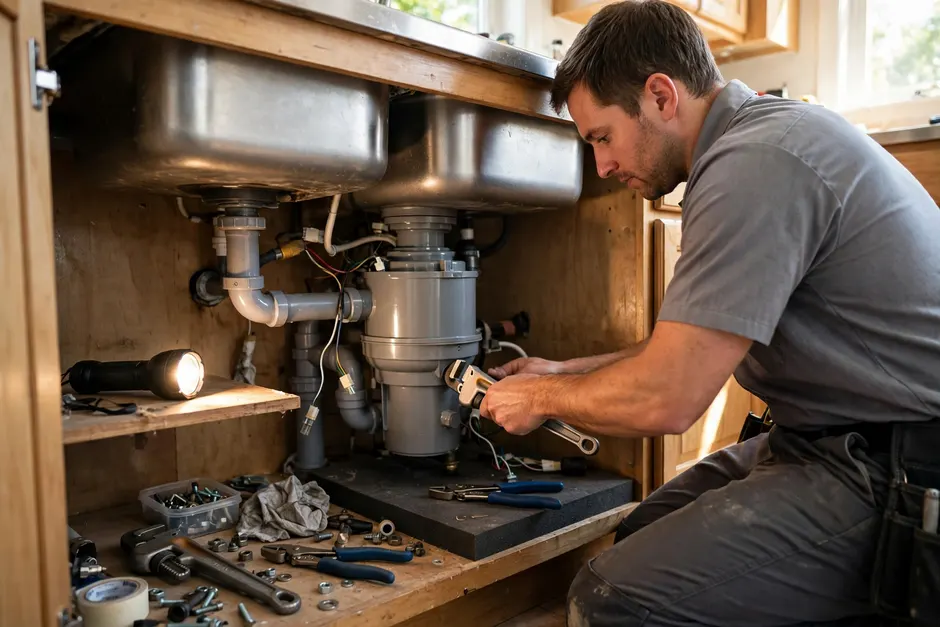
Disposals and septic tanks, and other uneasy partnerships
If your Thompson's Station home runs on a septic system rather than the town sewer, the disposal deserves a more cautious friendship. Everything the grind chamber shreds still has to be digested by the bacteria in your tank, and ground food is harder work than the waste the system was sized for. Many septic professionals advise either skipping a disposal entirely or treating it as an occasional tool rather than a daily habit, pumping the tank on the shorter rhythm if it is used heavily. The bacteria do not read the disposal manual; they simply receive what arrives.
Older kitchens pose the opposite pairing problem: a modern, higher-powered unit discharging into vintage drain branches whose diameter and fall were designed for a sink alone. The surge of ground slurry can overwhelm a marginal branch that coped for decades with ordinary sink water. When we replace a unit in an older farmhouse kitchen, the branch gets a look and usually a clear while the trap is open, because fitting a stronger pump to a weaker pipe is how a disposal upgrade becomes a drain project. Match the machine to the house, in both directions, and the partnership stays an easy one.
After the grind: where the particles actually go
Grinding is only the first act. What leaves the chamber is a slurry of fine particles in water, and its safe passage depends on velocity: enough water, moving fast enough through a branch with honest fall, carries the particles to the main and away. Starve the flow (a trickle instead of a full cold stream) or send the slurry into a flattened, grease-lined branch, and particles settle exactly where velocity dies, building a soft dam that later pours will top up. This is the physics behind the cold-water rule and behind the advice to run the tap a few seconds after the grinding stops: you are not rinsing the machine, you are escorting its output through the slow country of the branch line.
Particle size writes the sequel. A healthy unit reduces scraps to a fine, even grit that behaves almost like a liquid load. A tired unit with worn impellers and a scored grind ring passes coarser fragments that settle sooner and mat together, which is one reason an ageing disposal and a slowing kitchen drain so often arrive as a pair. If your sink has begun draining like it is thinking about it, do not assume the branch alone is guilty. The machine above it may be sending down a rougher product than the pipe was ever asked to carry, and the two deserve a joint inspection before either is condemned.
A field guide to things we have fished out of disposals
Every plumber keeps an informal museum of retrieved objects, and Thompson's Station kitchens have contributed generously. Bottle caps lead the collection by a distance, followed by twist ties, bread clips and the stones from the bottom of plant pots that get rinsed in the sink exactly once. November brings its own category: turkey bones beyond the machine's ambition, the plastic timer that popped out of the bird and went down with the washing up, and on one memorable occasion a teaspoon that had been missing, according to its owner, since Easter. December contributes candle wax, poured in warm and set like concrete in the chamber, and the occasional ornament hook.
The retrieval etiquette matters more than the comedy. Power off, tongs out, never fingers, and if the object is precious (a ring has featured twice in our local history, both times recovered), call before you run the unit again, because one grind can throw jewellery into the trap or beyond it. A chamber cleared by retrieval and tested with plain water is a happy ending. A chamber cleared by optimism and the switch is how a five-minute story becomes a replacement, and the museum gains another, sadder exhibit.
The don't list
Do not put grease, oil or fat down in any quantity, hot water and detergent notwithstanding; it coats the branch and builds the film that clogs Thompson's Station kitchen lines month after month. Do not feed celery, onion skins, corn husks or other string; artichoke leaves are the worst offenders in a distinguished field. Do not rely on the disposal for coffee grounds (they accumulate like sediment in traps and low spots), pasta, rice, oats or potato peelings, which swell or paste. Do not put drain cleaner into a disposal; it damages seals and makes any later work nastier.
And the regret medley, collected from homeowners who learned in person: the fish tank gravel, the flower stems, the child's small toy, the twist tie that sounded like the end of the world. The disposal is not judging you. Just switch it off, reach for the tongs, and check the chamber before the next run.
| Item | What it points to |
|---|---|
| Plate scraps, soft food, small bones | Fine, in small amounts, with cold water |
| Ice cubes and citrus peel | Good for the chamber |
| Grease, oil, cooking fat | Never. Into a can, then the bin |
| Celery, onion skin, coffee grounds, pasta | Bin or compost, not the disposal |